
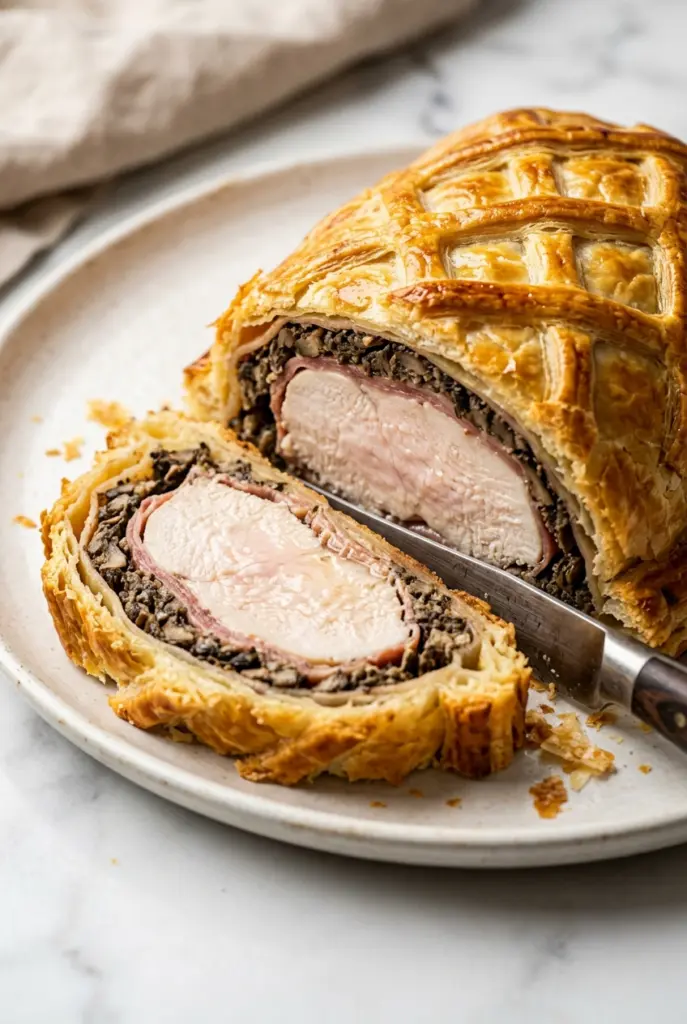
Chicken Wellington with Mushroom Duxelles
Golden puff pastry wrapped around juicy chicken and a dark, savory mushroom duxelles has that rare kind of dinner drama that still feels grounded in real cooking. The pastry shatters…
Tip: save now, cook later.Golden puff pastry wrapped around juicy chicken and a dark, savory mushroom duxelles has that rare kind of dinner drama that still feels grounded in real cooking. The pastry shatters when you cut into it, the mushrooms bring deep earthy flavor, and the chicken stays tender because it gets a quick sear first, then finishes gently inside the oven. It looks like a restaurant plate, but the method is straightforward once you understand the order of the steps.
The part that makes this work is moisture control. Mushrooms release a lot of liquid, and if the duxelles stays wet, the pastry underneath turns limp before it ever gets a chance to puff. The chicken also needs to cool before it’s wrapped, or the butter in the pastry starts softening too soon. Those two details are the difference between a crisp Wellington and a soggy one.
Below, I’ll walk through the exact texture cues I watch for, how dry the mushroom filling needs to get, and the small rest times that keep everything neat when you slice it. Once you’ve made it this way, the whole process feels much less fussy and a lot more repeatable.
The mushroom layer cooked down until it was dry and spreadable, and the pastry stayed crisp all the way through. I was nervous about the chicken drying out, but the timing was perfect and the slices came out clean.
Save this Chicken Wellington with Mushroom Duxelles for the kind of dinner that needs crisp pastry, a dry mushroom filling, and a clean slice every time.
The Moisture Problem That Ruins Most Chicken Wellingtons
The biggest mistake here is treating the duxelles like a quick mushroom sauté. It needs to cook down until it loses its raw look, turns dark and glossy, then dries out enough to hold its shape when you drag a spoon through it. If it still looks wet in the pan, it will steam the pastry from the inside and leave you with a pale bottom and a soft seam.
The other place people lose the texture is rushing the cooling time. Warm chicken softens the puff pastry before it ever hits the oven, and warm duxelles does the same. Cool both fillings completely, and give the wrapped logs a chill before pastry wrapping and again before baking. That short rest is what helps the pastry stay tight and puff cleanly.
- Cook the mushrooms until there’s no visible liquid left in the pan.
- Let the chicken cool before brushing on the mustard and wrapping.
- Chill the wrapped logs so the shape stays neat while you work.
- Use a hot oven so the pastry starts lifting before the filling can leak.
What Each Ingredient Is Actually Doing in This Dish
- Cremini or button mushrooms — These are the base of the duxelles, and they need to be chopped finely so they cook down into a spread, not a chunky filling. Cremini bring a little more depth, but regular button mushrooms work fine if that’s what you have.
- Prosciutto — This layer adds salt and acts like a thin barrier between the moist mushroom filling and the pastry. It’s worth using thin slices, because thick slices are harder to wrap tightly and can create bulky seams.
- Dijon mustard — The mustard adds sharpness and helps the chicken taste seasoned all the way through. Brush it on after searing and cooling so it doesn’t burn in the skillet.
- Puff pastry — This is the part that gives you the crisp, flaky shell, so use a good all-butter pastry if you can find it. If you only have standard frozen puff pastry, it still works well as long as you keep it cold and don’t overwork it.
- Dry white wine — Optional, but useful if you want a little acidity in the mushroom mixture. Add it early so it cooks off completely; any leftover liquid works against the texture you want.
Building the Layers So the Pastry Stays Crisp
Searing the Chicken Without Cooking It Through
Pat the chicken dry before it ever touches the pan. You’re looking for a deep golden crust on both sides, not a fully cooked center, because the oven finishes the job later. If the breast is thick on one end, press it gently in the skillet so it sears more evenly. Pull it out as soon as it has color and let it cool all the way down before the mustard goes on.
Cooking the Duxelles Until It’s Dry Enough to Spread
Melt the butter, cook the shallot and garlic until soft, then add the chopped mushrooms and thyme. At first the mushrooms will look crowded and wet; then they’ll collapse, darken, and start to sizzle as the moisture leaves. Keep stirring and scraping the pan so nothing scorches at the edges. The finished mixture should cling together and look almost paste-like, not loose or saucy.
Wrapping Tight Before the Pastry Goes On
Lay the prosciutto in a neat rectangle, spread the cooled duxelles over it, then roll the chicken up firmly with plastic wrap to shape it into a log. That log needs a short chill so it firms up and won’t fight the pastry later. When you wrap the pastry around it, press out air pockets and seal the seam with your fingers. Loose wrapping leaves gaps, and gaps turn into leaks.
Baking to a Deep Golden Finish
Brush with egg wash, score the top lightly, and bake in a fully preheated oven. The pastry should turn deep golden and feel crisp when tapped, while the chicken reaches a safe 74°C / 165°F in the center. If the top is browning too fast before the chicken is done, the oven is too hot or the pastry was warmed too long before baking. Let it rest a few minutes before slicing so the juices settle and the layers hold.
Three Ways to Adapt the Wellington Without Losing the Point
Gluten-Free Version With the Right Kind of Pastry
Use a gluten-free puff pastry if you can find one that rolls without cracking. The filling stays the same, but gluten-free pastry often browns a little faster and can be more fragile, so keep the seams tight and watch the oven closely in the last few minutes.
Dairy-Free Without Losing the Mushroom Depth
Swap the butter for a neutral dairy-free butter alternative or olive oil. You’ll lose a little richness, but the duxelles still gets the same dry, concentrated texture as long as you cook it down properly.
Skipping the Pork Layer
If you don’t use prosciutto, add an extra careful chill after rolling so the duxelles firms up and stays in place. The result is still good, but the pastry has less built-in protection against moisture, so the mushroom mixture has to be drier than ever.
Making It Ahead for a Dinner Party
You can assemble the chicken in prosciutto and duxelles earlier in the day, then wrap in pastry closer to baking time. That keeps the pastry from absorbing too much moisture while still giving you most of the work done before guests arrive.
Storage and Reheating
- Refrigerator: Store leftovers tightly wrapped for up to 3 days. The pastry softens a bit, but the flavor holds up well.
- Freezer: Freezing after baking isn’t ideal because the pastry loses its crispness. If you want to freeze it, do it before baking, then bake from chilled for the best texture.
- Reheating: Reheat in a 175°C / 350°F oven until warmed through. The microwave makes the pastry rubbery and steams the crust, which is the fastest way to lose the whole point of the dish.
Answers to the Questions Worth Asking
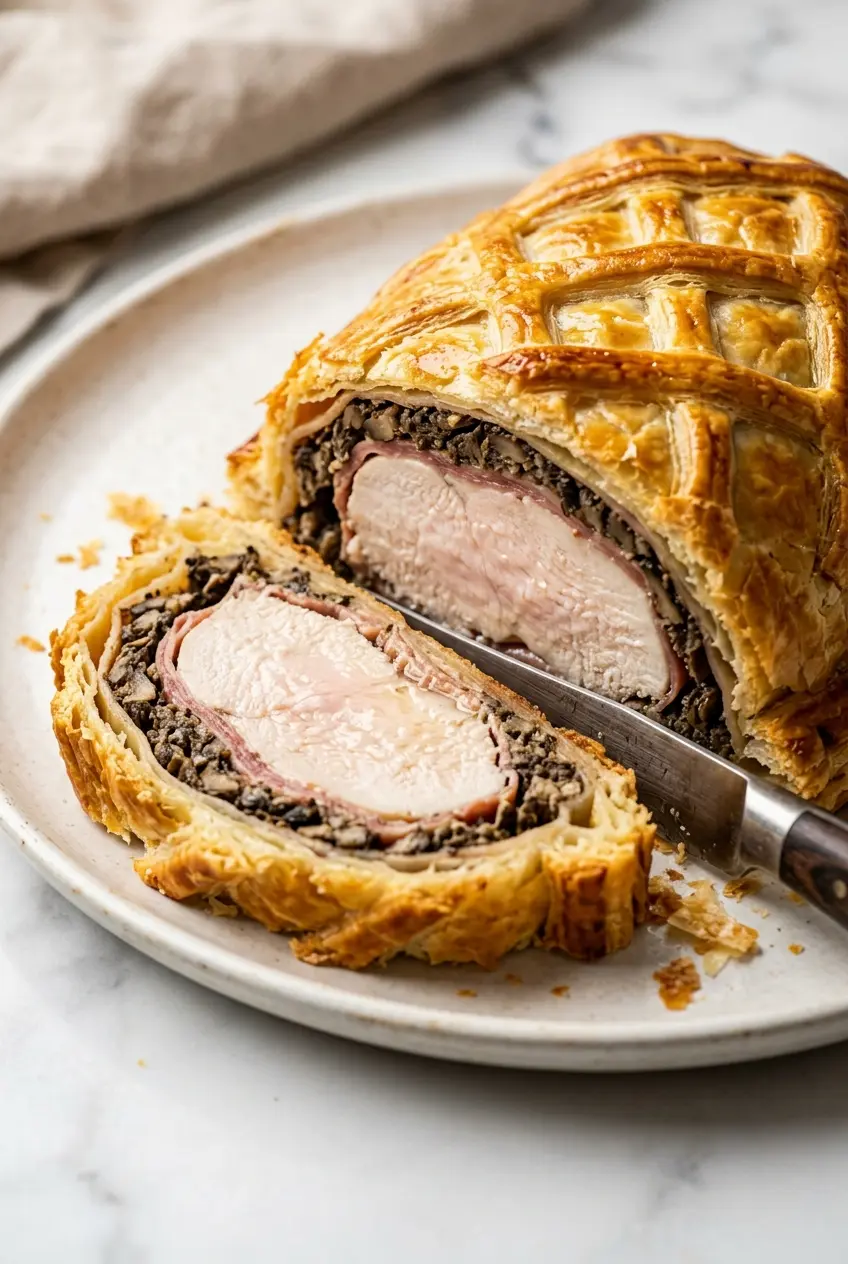
Chicken Wellington with Mushroom Duxelles
Ingredients
Equipment
Method
- Pat the chicken breasts dry, then season generously with salt and black pepper. Heat olive oil in a skillet over high heat until hot.
- Sear each chicken breast for 2 minutes per side until golden, leaving the center undercooked (do not cook through). Remove to a plate and let cool completely.
- Brush all sides of the cooled chicken breasts with Dijon mustard.
- In the same pan over medium heat, melt the unsalted butter. Add the shallot and garlic and cook for 2 minutes until soft.
- Add the finely chopped mushrooms, thyme leaves, salt, and black pepper. Cook over medium-high heat, stirring frequently, for 12–15 minutes until the mixture is dry and paste-like.
- If using, add the dry white wine halfway through cooking. Continue until fully dry—no moisture should remain.
- Spread the duxelles onto a plate. Refrigerate until cool.
- On a sheet of plastic wrap, lay out 3–4 slices of prosciutto di Parma slightly overlapping to form a rectangle large enough to wrap one chicken breast.
- Spread half the cooled mushroom duxelles evenly over the prosciutto layer.
- Place one seared chicken breast at the edge of the prosciutto-duxelles layer. Roll tightly into a log using the plastic wrap and twist the ends to secure.
- Repeat with the second chicken breast. Refrigerate for at least 30 minutes (up to 4 hours) to firm up.
- On a lightly floured surface, roll each puff pastry sheet to about 3mm thick. Remove the plastic wrap from each chicken roll.
- Place a chicken roll at the edge of a pastry sheet and roll tightly, pressing firmly to seal the edges and ends. Trim any excess pastry.
- Brush all over with egg wash. Refrigerate for 15 minutes.
- Preheat the oven to 200°C / 400°F. Remove the Wellingtons from the fridge and brush again with egg wash.
- Score the top lightly in a decorative pattern with a sharp knife. Sprinkle with flaky sea salt.
- Place the Wellingtons on a parchment-lined sheet pan. Bake for 22–26 minutes until deep golden and an internal thermometer reads 74°C / 165°F.
- Let the Wellingtons rest for 5 minutes before slicing.
- Using a sharp serrated knife, cut each Wellington into thick slices to reveal the layers of golden pastry, dark mushroom duxelles, and juicy chicken. Serve immediately.