

Best Sausage Stuffing
When sausage hits a warm skillet, it starts to brown at the edges and leaves little savory bits on the bottom of the pan. I keep those right where they…
Tip: save now, cook later.When sausage hits a warm skillet, it starts to brown at the edges and leaves little savory bits on the bottom of the pan. I keep those right where they are; the onion and celery soften in the same skillet, picking up all that flavor before the bread goes in. That’s the start of my best sausage stuffing, with plenty of sausage tucked through the cubes instead of gathered in a few bites.
Unseasoned dried bread cubes give me room to control the seasoning, while broth and eggs turn the mixture tender without making it heavy. I toss the liquid through gently and look for cubes that feel damp all the way around, not swimming in broth. The covered bake gives the center time to heat through, then the uncovered finish turns the top golden.
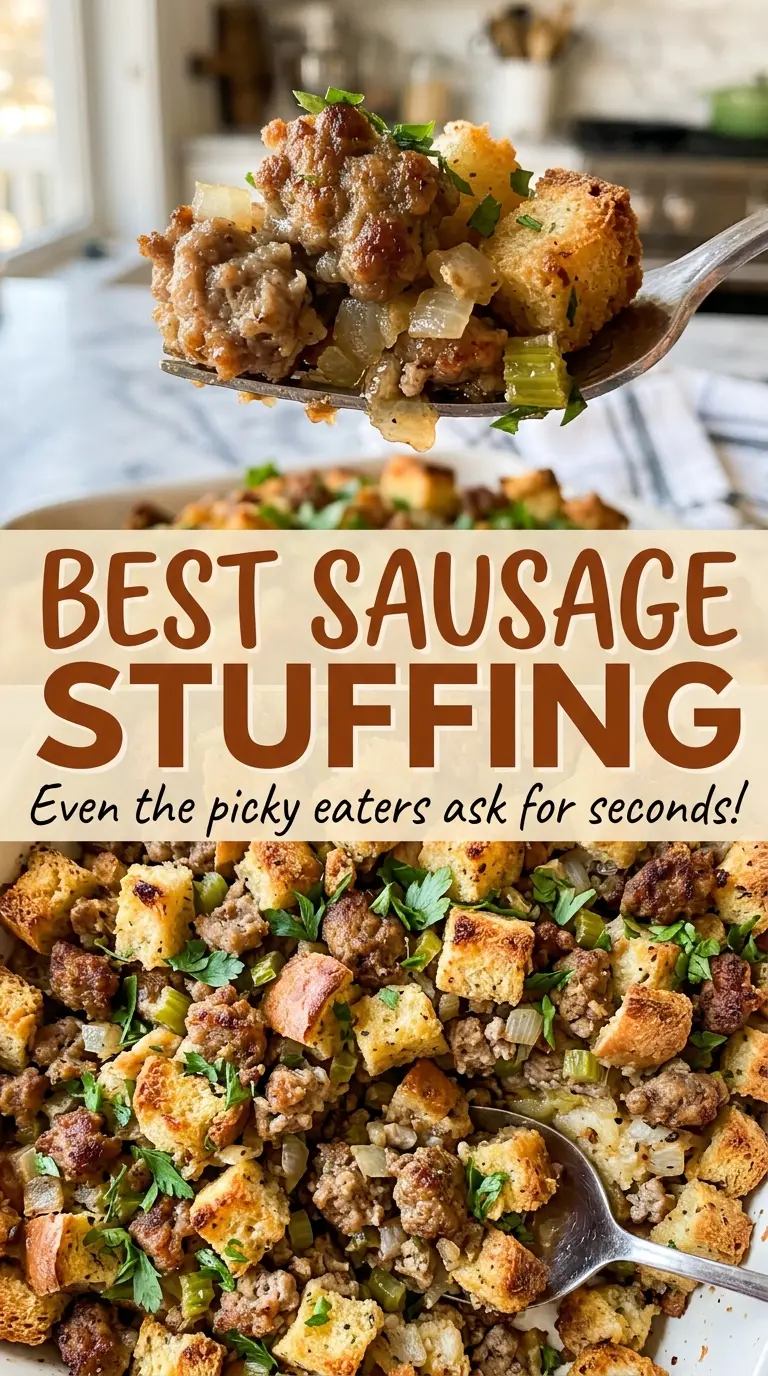
It’s a straightforward holiday side, but the texture depends on a few small cues: browned sausage, softened vegetables, evenly moistened bread, and a proper rest before serving. The finished stuffing has a crisp top, a tender middle, and savory sausage in every scoop.

Kitchen Note
Give the stuffing its full 10-minute rest after baking. It settles enough to scoop neatly, and the center stays tender instead of collapsing onto the serving spoon.
Save this Best Sausage Stuffing for a crisp-topped casserole with browned Italian sausage and a soft, savory center.
Why Dry Bread Cubes Make the Difference Between Tender and Soggy Stuffing
Stuffing needs bread that can take in broth without immediately falling apart. These unseasoned dried cubes start firm, so they absorb the egg-and-broth mixture while holding their shape. That gives you distinct, tender pieces in the middle rather than a uniform, pasty layer.
Pouring the liquid over the bread is only half the job. Toss until the cubes are evenly damp, including the pieces near the bottom of the bowl; a dry patch can stay tough after baking, while a puddle of liquid signals that the mixture hasn’t been distributed evenly. The bread should look moistened, not soaked through to the point of breaking down.
The covered bake gives that moisture time to move through the dish without the top drying out too soon. Uncovering for the final stretch lets the surface turn golden. I use the center—not the color of the top—to judge when the stuffing is ready to come out.
The Sausage, Bread, and Broth Choices That Shape Every Bite
- Mild Italian sausage — Its seasoning brings the savory backbone, and browning it well adds more depth than simply cooking it until no pink remains. Buy bulk sausage or remove the casings before cooking, then break it into small pieces so it spreads through the casserole.
- Unseasoned dried bread cubes — These are the structure of the dish, and unseasoned cubes let the sausage, sage, and thyme stay in balance. Choose a bag of dry, firm cubes rather than soft fresh bread; seasoned cubes can make the overall seasoning harder to control.
- Unsalted butter, onion, and celery — Butter carries the flavor of the softened vegetables through the bread. Dice the onion and celery evenly so they soften at the same pace. Unsalted butter also leaves the salt level easier to manage alongside the sausage and broth.
- Low-sodium chicken broth and eggs — Broth moistens the cubes, while the eggs help the baked mixture hold together. Whisk them with the herbs and seasonings first so they’re distributed throughout instead of leaving concentrated pockets.
- Fresh parsley, rubbed sage, and dried thyme — Parsley gives the mixture a fresh herbal note, while rubbed sage and thyme bring the familiar savory stuffing flavor. Chop the parsley before tossing it in, and use rubbed sage rather than assuming ground sage will measure or taste the same.
How to Brown the Sausage and Bake the Stuffing Without Drying It Out
Brown the sausage in the skillet
Heat the oven to 350°F and grease a 9×13-inch baking dish. Cook the sausage in a 12-inch skillet over medium heat, breaking it into small pieces as it browns. It takes 8 to 10 minutes; check that it’s cooked through to 160°F, then transfer it to a large bowl. If the pieces stay in large clumps, break them up before they go into the bread so the sausage is spread through the dish.
Soften the onion and celery in the same pan
Melt the butter in the skillet you used for the sausage, then add the diced onion and celery. Cook for 6 to 8 minutes, stirring occasionally, until the vegetables have softened. The onion should look translucent at the edges, and the celery should no longer seem raw and rigid. Keep the heat at medium so the vegetables soften without browning before they’re tender.
Toss the bread with the sausage and herbs
Add the dried bread cubes, cooked sausage, softened onion mixture, and chopped parsley to the large bowl. Toss until the sausage and vegetables are spread through the cubes rather than sitting in one spot. In a separate medium bowl, whisk together the broth, eggs, rubbed sage, dried thyme, kosher salt, and black pepper. Pour it over the bread mixture and toss gently until the cubes are evenly moistened.
Bake covered, then brown the top
Transfer the mixture to the greased baking dish and cover it tightly with foil. Bake at 350°F for 30 minutes, then remove the foil and continue baking for 15 to 25 minutes, until the top is golden and the center reaches 165°F. A browned surface doesn’t mean the middle is ready, so check the center before taking the dish out. Rest the stuffing for 10 minutes before serving.
Three Easy Ways to Adapt the Sausage Stuffing
Make it gluten-free
Replace the unseasoned dried bread cubes with the same amount of unseasoned gluten-free dried bread cubes. They may absorb broth differently from wheat bread, so toss gently and check that the cubes are evenly moistened before transferring the mixture to the baking dish.
Use hot Italian sausage for more heat
Swap the mild Italian sausage for hot Italian sausage. The casserole keeps its same meaty texture, but the peppery heat comes through more clearly against the buttery bread and herbs.
Make it dairy-free
Use an equal amount of unsalted dairy-free butter in place of the butter. Choose a firm baking-style butter alternative rather than a soft tub spread; the result will be slightly different in richness, but the vegetables will still soften in the skillet as they should.
Storage and Reheating
- Refrigerator: Refrigerate leftovers within 2 hours and keep them covered for 3 to 4 days. The crisp top will soften as the stuffing chills.
- Freezer: Freeze cooled portions in an airtight container for up to 2 months for best texture. Thaw overnight in the refrigerator before reheating.
- Reheating: Warm covered in a 350°F oven until hot throughout, then uncover briefly if you want to bring back some crispness on top. Microwaving a large portion can soften the surface and warm it unevenly.
Questions That Come Up When Making Sausage Stuffing
Best Sausage Stuffing
Ingredients
Equipment
Method
- Heat the oven to 350°F.
- Grease a 9x13-inch baking dish.
- Cook the sausage in a 12-inch skillet over medium heat, breaking it into small pieces, until browned and cooked through to 160°F, 8 to 10 minutes.
- Transfer the sausage to a large bowl.
- Melt the butter in the same skillet.
- Add the onion and celery, and cook until softened, 6 to 8 minutes.
- Add the bread cubes, sausage, onion mixture, and parsley to the bowl and toss to combine.
- Whisk the broth, eggs, sage, thyme, salt, and pepper in a medium bowl.
- Pour the broth mixture over the bread mixture and toss until evenly moistened.
- Transfer the mixture to the prepared baking dish and cover tightly with foil.
- Bake at 350°F for 30 minutes.
- Uncover and bake until the top is golden and the center reaches 165°F, 15 to 25 minutes.
- Rest for 10 minutes before serving.
